
Moving a shipping container on Queensland roads is not as straightforward as hitching a load and driving. There is a layer of legal compliance, permit requirements, and route planning that sits between you and a successful container transport jobs and getting any part of it wrong can result in fines, vehicle damage, or worse, a serious road incident. Understanding container towing laws Queensland operators and businesses must follow is the first step toward moving containers safely, legally, and without unnecessary delays or costs.
Whether you are a Brisbane business relocating a storage container, a construction company moving equipment, or a logistics operator managing regular container movements, the rules that apply to your job are detailed and specific.
Container Towing Rules in Queensland
Queensland's key towing regulations include the Tow Truck Act 2023 and Tow Truck Regulation 2024, which cover accreditation of tow truck operators, drivers, and equipment used for crash-related and private-property towing. For container transport specifically, the National Heavy Vehicle Regulator is known as the NHVR and governs the movement of heavy loads across Queensland roads, working alongside the Department of Transport and Main Roads, or TMR.
Container towing rules in Queensland require that any load exceeding standard mass and dimension limits must be covered by the appropriate permit before the vehicle moves. Queensland uses the TMR network maps for heavy loads and requires additional notices for some vehicle types.
Both the vehicle and trailer must be registered and roadworthy at all times, and the trailer must have an illuminated rear number plate that is clearly visible and not obscured by any accessories. For container towing, this means the trailer or skeletal frame carrying the container must meet all relevant Australian Design Rules and be in a condition that satisfies a roadside inspection if one occurs during transit.
Driving Licence Requirements
The licence required to tow a shipping container in Queensland depends on the weight and configuration of the vehicle and load combination. A standard car licence is not sufficient for most container towing jobs. Moving a loaded 20-foot container requires a heavy vehicle licence, typically a Medium Rigid or Heavy Rigid licence at minimum, depending on the towing vehicle's Gross Vehicle Mass.
For very heavy or oversize container movements using Class 4 tow trucks or prime movers with trailer combinations, operators must possess a current NHVR Scheme permit and comply with the Scheme conditions. A Class 4 tow truck must have a GCM of at least 25 tonnes as defined by Vehicle Standard Australian Design Rule 44.
This means container towing is not a job for an unlicensed operator or a standard ute driver who simply attaches a trailer and drives. The licence class, vehicle rating, and permit must all align with the specific load being transported. Queensland TMR officers conduct random heavy vehicle inspections on major routes including the M1, Ipswich Motorway, and Logan Motorway — and non-compliance is identified and penalised on the spot.
Learner drivers are generally allowed to tow trailers subject to conditions and supervision, but this applies only to light trailers under standard towing conditions, never to commercial container transport operations.
The 110 20 Rule for Container Towing
One of the most important rules to understand when planning any container towing job in Queensland is what is commonly referred to as the 110/20 rule. This rule states that the trailer's total loaded mass must not exceed 110 percent of the towing vehicle's Gross Vehicle Mass, and the tow ball download must not exceed 20 percent of the trailer's total loaded mass.
In practical terms, the weight pushing down on the tow coupling from the container load must sit within a specific range. Too much tow ball weight destabilises the towing vehicle and reduces steering control. Too little causes the trailer to sway — a dangerous condition at highway speeds on Queensland motorways.
For shipping container towing, the 110/20 rule is particularly important because container loads can shift during transit. An improperly loaded or unevenly packed container can alter the tow ball mass mid-journey, taking it outside the legal and safe range without the driver realising. Always ensure containers are loaded evenly and that the mass distribution is confirmed before the vehicle moves.
Can You Tow a 20ft Container
A 20-foot shipping container has a tare weight of approximately 2,200 kilograms when empty. When loaded, that figure can rise to 20,000 kilograms or more depending on the contents. This immediately rules out any standard passenger vehicle or light commercial ute as a viable towing option for a loaded 20-foot container.
An empty 20-foot container can theoretically be moved by a heavy duty ute or light truck with an appropriate trailer rated for the load — but the legal requirements still apply in full. The trailer must be rated for the container's weight, the vehicle must hold the correct licence class, and the overall combination must not exceed the legal dimension limits without a permit.
The maximum allowable width for a trailer and load without special permits in Australia is 2.5 metres, and the total length including vehicle and trailer must not exceed 19 metres. A standard 20-foot container is 2.438 metres wide — just inside the standard limit — but the skeletal trailer adds length to the combination that must be carefully calculated before the job begins.
For a loaded 20-foot container, a semi-trailer or prime mover combination is the correct and only appropriate equipment. Attempting to move a fully loaded container with an under-rated vehicle is both illegal under container towing laws Queensland enforces and genuinely dangerous for every road user nearby.
Shipping Container Transport by Pickup
This is one of the most commonly misunderstood areas of container towing rules — whether a pickup truck or heavy duty ute can legally and safely transport a shipping container in Queensland.
The short answer is that a pickup truck can only be used to move a very light, empty container over a short distance if the trailer, tow bar, and vehicle are all rated appropriately for that specific load. Even then, the full legal requirements around registration, permits, and licence class still apply.
Most pickup trucks have a towing capacity of between 2,500 kilograms and 3,500 kilograms — which is insufficient for any loaded shipping container and marginal even for an empty 20-foot unit. The risk of tow bar failure, trailer instability, and brake overload when attempting to move a container with an under-rated pickup is significant and well documented.
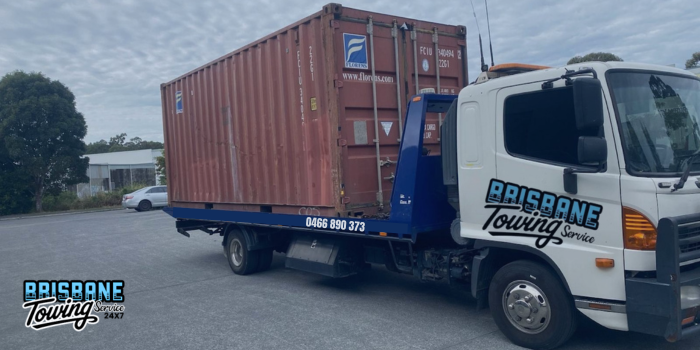
For any container movement beyond a very light, short-distance empty container job, a purpose-built skeletal trailer pulled by a prime mover or heavy rigid truck is the correct and legal choice. Brisbane businesses that regularly move containers should engage a licensed heavy vehicle operator rather than attempting to manage the job with general-purpose tow vehicles and risk the penalties that follow.
Typical Pricing Estimates for Shipping Container Moves
Brisbane container towing cost varies depending on container size, distance, permit requirements, and the type of equipment needed. Understanding typical pricing before requesting a quote helps you evaluate whether you are receiving a fair rate and plan your project budget accurately.
For a local container move within the Brisbane metro area — from a depot in Acacia Ridge to a construction site in the CBD for example — expect to pay between $350 and $600 for an empty 20-foot container. A loaded 20-foot container over the same distance typically runs between $500 and $900 depending on the complexity of access at both ends of the job.
For a 40-foot container, Brisbane container towing cost increases proportionally. A local empty 40-foot move generally sits between $450 and $750, while a loaded 40-foot container in the Brisbane region can range from $700 to $1,200 or more if access conditions require additional equipment or extended setup time on site.
Long distance container moves from Brisbane to the Gold Coast, Ipswich, or the Sunshine Coast add distance-based charges on top of the base rate. Container towing laws Queensland regulations require that permit costs for oversize or overmass movements are factored into the total job cost — these can range from $80 to $400 depending on the permit type and route complexity involved.
Always request an itemised quote from your container towing operator that clearly separates the transport cost, permit cost if applicable, and any after-hours or access surcharges. A reputable operator will provide this breakdown without hesitation.
Permits and Route Planning for Container Transport
Transporting oversized or overmass loads requires the right permits to ensure safety and compliance with container towing laws Queensland authorities enforce on every major road corridor. For container towing, this means contacting the NHVR directly or working with a transport operator who manages permits on your behalf as part of the service.
Route planning is equally important and cannot be treated as an afterthought. You need to avoid built-up areas during peak traffic hours and stick to designated oversize routes where available. In Brisbane, this means planning container movements to avoid school zones, peak hour windows on the M1 and Ipswich Motorway, and bridge crossings with weight or height restrictions that would make the movement non-compliant.
Non-compliance exposes operators to significant fines, vehicle defect notices, and potential liability in the event of an incident during transit — none of which are worth the risk when the correct permit process is straightforward and available.
Brisbane Towing Service — Container Transport Specialists
Brisbane Towing Service 24*7 handles container towing across Brisbane, Logan, Ipswich, and the Gold Coast with full compliance to Queensland towing laws and NHVR requirements. Our team manages permit applications, route planning, and equipment selection for every container job — so you do not have to navigate the legal complexity alone.
Every container towing job we complete is covered by appropriate insurance, operated by licensed heavy vehicle drivers, and priced transparently with no hidden charges.