
Pulling a car behind a motorhome on all four wheels sounds simple, until you learn that the wrong car can wreck its own transmission before you have left the driveway. Plenty of Australian travellers want a second vehicle at their destination, and flat towing vehicle is one of the most practical ways to get it there, but only certain cars are built for it. This guide explains how flat towing works, which types of vehicles are commonly suitable in Australia, how Queensland’s rules apply and when it is smarter to use a flatbed. And if your car turns out not to be suitable, a tow truck service in Brisbane like ours can move it safely on a flatbed so nothing is put at risk.
What Flat Towing Actually Means
Flat towing, also called four-down or A-frame towing, means towing a vehicle behind another with all four wheels on the road. There is no trailer and no dolly. In Australia, the towed car is usually connected to the motorhome’s tow bar through an A-frame fixed to the front of the towed vehicle, and its wheels keep turning the whole way.
It is easy to mix this up with other terms. A flatbed carries the car on top of the truck with all four wheels off the road. A dolly lifts only the drive wheels. A car with flat tyres is simply a car in a particular condition and has nothing to do with the towing method. Flat towing vehicle is the only one of these where the car’s own drivetrain has to cope with being turned by the road.
Why Some Cars Can Be Flat Towed and Others Cannot
In most automatic cars, the transmission is properly lubricated only while the engine is running. Tow it with the engine off and the wheels spinning the gearbox, and it can overheat and wear out in a surprisingly short distance. A manual gearbox in neutral, or a part-time four-wheel drive with a true neutral position in its transfer case, lets the wheels turn without driving the transmission, which is why those vehicles dominate flat towing lists.
Full-time and on-demand all-wheel-drive cars, most CVT and dual-clutch automatics and electric vehicles are generally poor candidates. Many electric and hybrid systems can be damaged when the wheels spin, and manufacturers usually say plainly that these cars must go on a flatbed.
Flat Towable Vehicles Available in Australia
Manufacturers publish their own approvals, and these can change by year, market and trim, so treat this section as a starting point rather than a final answer. Many online lists are built around American models, and a lot of those cars were never sold in Australia, so it helps to focus on what you can actually buy here.
Jeep Wrangler and Gladiator: The Wrangler is the most popular choice for motorhome owners, because its part-time four-wheel-drive system has a neutral position in the transfer case. The Gladiator is widely flat towed the same way. Procedures differ between manual and automatic versions and between model years, so follow the owner’s manual for your exact vehicle. The Wrangler 4xe plug-in hybrid is not approved for flat towing.
Suzuki Jimny: A common small 4WD choice, but not every Jimny is the same. Some can be flat towed as they are, while others have needed a transmission modification, so confirm your exact model before you buy an A-frame.
Suzuki Grand Vitara: Many automatic versions can be flat towed vehicle because the transfer case has a neutral position that isolates the main transmission, although some variants, such as certain older three-door models, cannot.
Other part-time 4WDs and manuals: Selected manual-transmission 4WD utes and wagons with a true neutral transfer case may qualify. Some compact manuals, such as the Fiat 500 and MINI Cooper, appear on approved lists overseas, so check whether the Australian-market version is covered before assuming it is.
On the other side, most front-wheel-drive and rear-wheel-drive automatics, full-time AWD vehicles and nearly all electric cars should not be flat towed.
Multi-Vehicle Accident In Brisbane Guide
Boat Hauling In Brisbane: 8 Things To Avoid
Move A Classic Car That Has Been Sitting For Years In Brisbane
Shopping Centre Car Park Towing Brisbane: How It Works
Vehicle Breakdown Spots In Brisbane And What To Do At Each One
How to Flat Tow a Jeep Wrangler
Owners who flat tow a Jeep Wrangler usually find it one of the easier setups, but the steps still matter. The transfer case needs to be shifted into neutral and the transmission set as the manual specifies for your year and gearbox, which differs between manual and automatic versions. The steering must stay unlocked, which usually means leaving the ignition in the accessory position so the front wheels can follow the motorhome through corners, and the parking brake has to be released.
The hardware matters as much as the procedure. You need a properly rated A-frame or baseplate system, safety chains or cables, working tail lights and indicators repeated on the towed car and a braking setup that suits your combination. A stone guard on the front of the towed vehicle is also worth fitting. Stop early in the trip to recheck every connection, note any speed or distance limits the manufacturer sets and plan breaks around them. Never reverse a flat-towed car, because backing up can bend the A-frame or damage the steering.
Checks Before You Flat Tow Any Vehicle
Before committing, confirm that the manufacturer approves flat towing vehicle for your specific year and model. Check the transmission type and whether the transfer case has a true neutral, and make sure the steering can be unlocked without starting the engine. Confirm that the A-frame, safety connections and tow bar are rated for the vehicle’s weight, and check that the combination has working lights and the braking the law requires. Finally, call your insurer, since some policies treat a flat-towed vehicle differently from one on a trailer.
Flat Towing Rules in Queensland
Flat towing with an A-frame is allowed across Australia, but the rules differ between states, so check the one you are travelling through. In Queensland, the towed vehicle’s brakes and steering must be in working order, lighting requirements apply, and there are towing mass limits and driver requirements. A-frame towing also has its own technical requirements, set out in a guide from Queensland’s Department of Transport and Main Roads. RACQ’s towing guide explains the basics in plain language.
One rule worth knowing is the towing mass ratio. If the towing vehicle is not at least 3.5 times the weight of the towed vehicle, the towed vehicle’s brakes generally need to operate with the brakes of the towing vehicle. Both vehicles also need to be registered and roadworthy, and your A-frame setup may need checking by an engineering signatory or certifier. If you plan to tour interstate, check each state’s rules, because they can differ at the border. Rules change, so always confirm the current requirements with the relevant transport authority before you travel.
When a Flatbed Is the Smarter Choice
Flat towing is not always the right tool. If your car is not approved, if it is an automatic, an electric vehicle or a full-time AWD, or if it is damaged and cannot roll or steer properly, a flatbed is the safer option. The same applies to long trips where you would rather not put kilometres on the towed car’s drivetrain at all. A flatbed lifts all four wheels off the road, so nothing in the drivetrain is asked to turn.
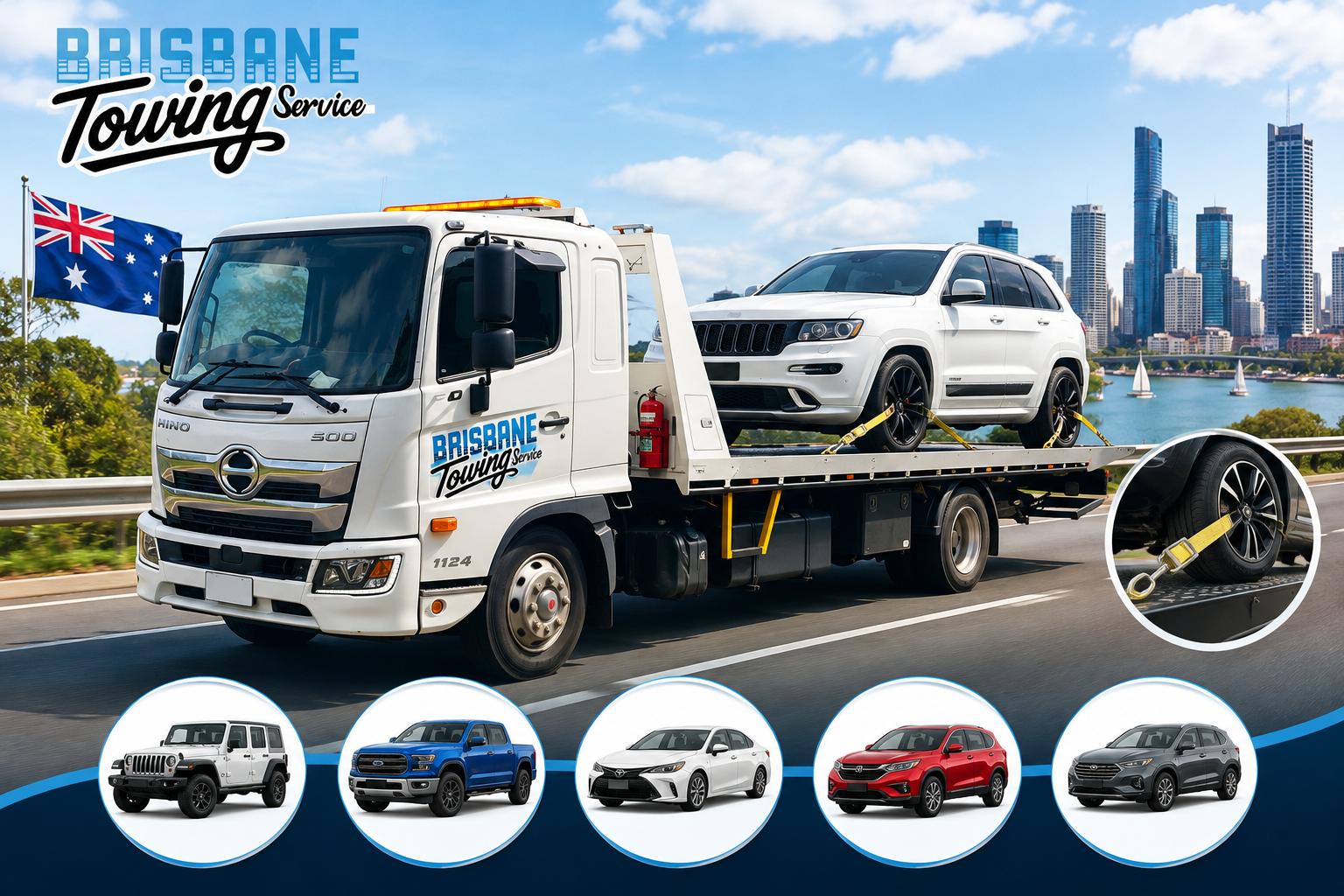
Brisbane Towing Service runs flatbed and tilt-tray trucks suited to different vehicles, including a low-angle tray for lowered cars, and you can see the full range on our Fleet page. For trips beyond Brisbane, our long distance towing service moves vehicles interstate on the same flatbed approach.
Frequently Ask Questions
Can an automatic car be flat towed?
Some older automatics can, but most modern automatics cannot unless the manufacturer specifically approves it. Check the owner’s manual for your exact year and model.
Can you flat tow a Jeep Wrangler with an automatic transmission?
In most cases yes, with the transfer case placed in neutral and the transmission set as the manual describes. Follow the procedure for your specific model year, and remember the Wrangler 4xe plug-in hybrid is not approved.
Can electric vehicles be flat towed?
Almost never. Most electric vehicles should be moved on a flatbed to avoid drivetrain damage.
Is flat towing legal in Queensland?
Yes, under conditions. Brakes, steering, lighting, towing mass and driver rules apply, and A-frame setups have their own technical requirements. Check the current requirements with Queensland Transport and Main Roads.
Can I reverse a car that is being flat towed?
No. Reversing can bend the A-frame and damage the steering, so unhitch the car or reposition the whole combination.
Do I need professional help to flat tow?
If you are unsure about compatibility, setup or the law, a professional operator can move the car on a flatbed and remove the guesswork.
Not Sure Your Car Can Be Flat Towed
If you cannot confirm your vehicle’s approval, or you would rather not risk the transmission, call Brisbane Towing Service on 0466 890 373. We will recommend the right method for your vehicle, confirm the price upfront and move it safely, 24/7 across Brisbane and surrounding suburbs. You can also read about our low vehicle towing and caravan and boat towing services.